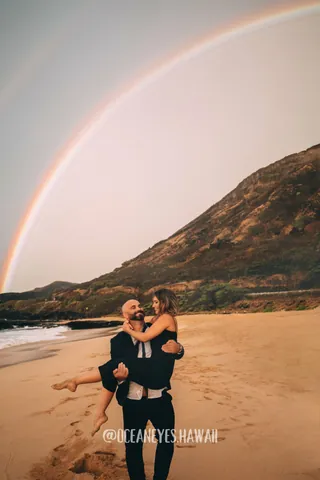
Half the island’s best views are twenty to forty minutes of walking away from a parking spot. Not a day hike, not gear, not an expedition — a short climb, a ridge, and suddenly the whole coast is laid out underneath you.
We walk up these trails carrying camera bags, often in the dark, often with clients who flew in yesterday and are wearing something impractical. That gives us a particular view of which ones are worth it: not the longest or the highest, but the ones where the ratio of effort to view is honest, the gate is actually open when you need it, and you can park without coming back to a ticket.
Seven trails, with what nobody mentions until you are already there.
1. Makapuʻu Lighthouse Trail — the easiest big view on Oahu
Two miles round trip, paved the whole way, about 500 feet of climb, free.
A wide asphalt road curls around the southeast headland to a lookout above the red-and-white lighthouse, with the Ka Iwi coast on one side and Rabbit Island offshore. There is no scrambling, no mud and nothing technical: the only difficulty is the steady uphill and the complete lack of shade.
The thing to plan around is the gate. This headland belongs to a state shoreline park whose gates open at 7:00 a.m., later than sunrise for most of the year, so dawn up here is not an option. Late afternoon is better anyway: the light comes from behind you onto the coastline, and the cliffs go warm.
From December through April this is one of the best whale-watching spots on the island, from dry land, for free. People walk past the lookout and never turn around; if you do, Koko Head and the long line of the coast are right there.
Good for: almost everyone, including grandparents who want a view without a scramble. Strollers can make it, with effort. Not good for: midday in summer, unless you like sunburn.
2. Diamond Head (Lēʻahi) — the famous one, with paperwork
About 1.6 miles round trip, 560 feet, stairs and a tunnel.
Everyone does this hike, and it earns the attention: you walk into a volcanic crater, up through a WWII tunnel and two long flights of stairs, and come out on a bunker at the rim looking down the whole Waikiki coastline.
Two things to sort out first. Out-of-state visitors need a reservation — entry is $5 per person and parking $10 per vehicle, booked online in advance, while Hawaii residents go free with ID. And the monument runs 6:00 a.m. to 6:00 p.m., with the last entry in the late afternoon, so plan the early slot rather than a golden-hour one.
Our honest take: go at opening. By nine the stairs are a queue, and the crater holds heat like a bowl. The view down to Waikiki is best in the first hour, when the city is still in haze and the water has that early blue.
Good for: kids over about six, anyone comfortable with stairs. Not good for: anyone hoping for solitude, or arriving without booking.
3. Kaʻiwa Ridge, the Lanikai Pillboxes — the best twenty minutes you will spend
Roughly 1.8 miles round trip, steep from the first step, dirt and loose rock.
Twenty to thirty minutes of unglamorous climbing gets you to the first concrete bunker and the view everyone has seen: Lanikai below, the two Mokulua islands offshore, Kailua Bay stretching north. Keep going and the ridge opens up further, with the Koʻolau on your left.
What the photos don’t show is the surface. The first section is red dirt over rock at an angle that is awkward going up and worse coming down, and it turns into a slide when it has rained. Shoes with grip, not sandals.
Parking is the other half of the problem. Lanikai is residential, the city has been making the no-parking rules along Mokulua and ʻAʻalapapa permanent, and the restrictions are enforced. Leave the car at Kailua Beach Park and walk fifteen minutes to the trailhead.
Good for: sunrise, if you bring a headlamp; anyone who wants one spectacular view for modest effort. Not good for: wet mornings, flip-flops, small children in the dark.
4. Ehukai Pillbox — the shaded one on the North Shore
About two miles round trip, mostly under trees.
This is the hike we send people to when the forecast says sun and they have children. The trail starts across the road from the elementary school at Sunset Beach, climbs through ironwood and banyan shade, and comes out at bunkers looking down on the North Shore reefs — including the stretch of water that becomes famous every winter when the surf arrives.
The shade is the point. Almost every other view hike on Oahu is exposed; this one you can do at ten in the morning without anyone melting. Roots and a few steep steps, nothing technical.
Good for: families, hot days, winter mornings when you want to see the surf from above. Not good for: anyone chasing an open panorama — the view is framed by trees, which is prettier and less wide.
5. Puʻu ʻUalakaʻa and Tantalus — a view you can drive to
Two minutes from the car, or a short loop trail if you want to walk.
Up in the hills behind the city, Puʻu ʻUalakaʻa State Wayside hands you all of Honolulu in a single frame: downtown, the harbor, Diamond Head at the far end, the ocean behind it all. You park, you walk across a lawn, you are there. For anyone who wants the island’s best city view and cannot do stairs, this is the answer.
The gate hours decide your plan: 7:00 a.m. until 7:45 p.m. in summer, until 6:45 p.m. after Labor Day. Winter sunsets fall comfortably inside that; in June the sun sets at 7:14 and you want to be moving toward the car as it does. The short ʻUalakaʻa trail loops into the forest from the same parking area if you want to stretch the visit.
6. Mānoa Falls — green, wet and completely different
About 1.6 miles round trip, muddy, in rainforest.
Fifteen minutes from Waikiki, the valley behind the university turns into something that belongs in a different film: bamboo, giant ferns, hanging roots, and a 150-foot ribbon of water at the end. Parking at the private lot is $7 and it opens at 8:00 a.m., so this is a mid-morning hike rather than a dawn one.
A photographer’s warning: the forest is dark, the waterfall is in shade, and the contrast between the two will break most phone cameras. Mid-morning on a bright day is the worst of it. An overcast day is better here than a sunny one — the whole valley becomes one soft green light box.
Do not swim in the pool at the bottom. Fresh water in Hawaii carries leptospirosis, and there is signage about it for a reason.
Good for: rain days, heat, anyone who wants jungle rather than coastline. Not good for: white dresses and clean shoes.
7. Maunawili Falls — the one to cross off
Worth knowing so you don’t waste a morning: the neighborhood trailhead has been closed since 2021 for a rebuild and still has no reopening date, even though every old blog post and video still sends people there. The falls themselves can be reached the long way round via the Maunawili Demonstration Trail from the Pali side, which is a proper half-day hike rather than a quick stop. If you have an hour, the six trails above are better uses of it.

Practical notes for all of them
Shoes. Trail runners or anything with grip. We have watched more than one person descend Kaʻiwa Ridge on their backside in resort sandals.
Water and timing. There is no shade on Makapuʻu, Diamond Head or Kaʻiwa. Start early or go late; the two hours around noon are miserable on all three.
Rain changes everything. Red dirt plus water equals a slide, and the windward trails take showers almost daily. If it rained overnight, pick Ehukai or the paved Makapuʻu.
Stay on the trail. The ridges have soft edges and the drops are real, and the hillsides either side are either private property or actively eroding. Photos that require stepping past a fence are not photos we take.
Leave it as you found it. These are everyday places for the people who live beside them — quiet voices at 5 a.m. in Lanikai, no parking across driveways, nothing left behind.
About permits. For your own photos, walk up and shoot whatever you like. Professional work on state land is a different matter: filming and commercial photography on state trails and parks go through the Hawaii Film Office, and a state park wants its paperwork weeks ahead. That part is our problem, not yours — we sort out the permissions for the places we take clients.
Shooting on a trail, in practice
A ridge session is not a beach session. The useful differences we have learned:
- Allow double the time the trail description says if anyone is in a dress or carrying a toddler. The climb is the session; the photos happen in the ten minutes at the top.
- Wind on a ridge is constant. Hair ties, and nothing that needs holding down.
- The best frames face away from the famous view. Everyone looks out at the islands; the light is usually better on the ridge line itself.
- Afternoon on the windward side puts the sun behind the mountains early, so the coast goes into soft shadow while the sky stays bright. That is a lovely light to be in, and it comes earlier than people expect — around four in winter.
Want these views with a photographer along?
We photograph on ridges, lookouts and coastlines all over Oahu, and we pick the trail around who is coming: how far they want to walk, what shoes exist in the suitcase, and where the light will be that afternoon. A 45-minute mini session at one spot is $399, an hour is $550, with a travel fee outside Honolulu. Everything we take is yours the next day; the edited set follows in 3–7 business days.
See our Oahu locations, the city lookouts around Honolulu if Tantalus was the one that caught your eye, or send us a message on Instagram with your dates — tell us whether you would rather earn the view or drive to it, and we will plan the morning from there.